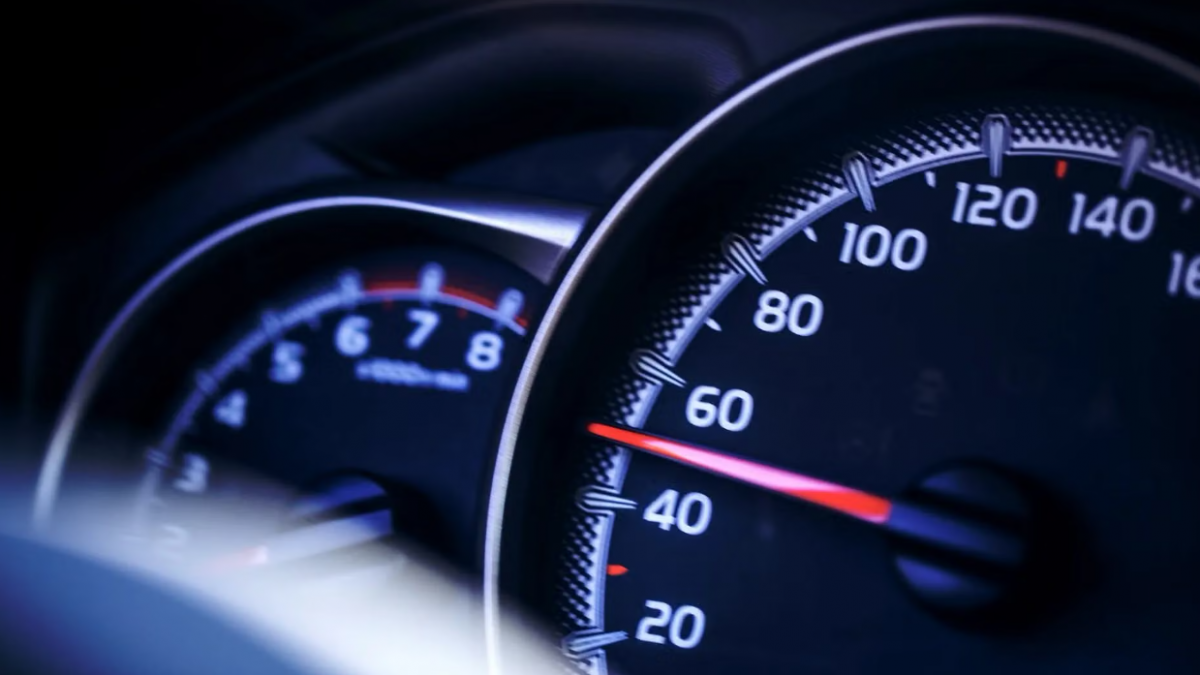
A speedometer and a tachometer are among the most familiar instruments on a vehicle’s dashboard. Although the gauges may look similar, they measure different things. The speedometer shows how fast the vehicle is traveling, while the tachometer tracks the rotational speed of the engine’s crankshaft.
Each serves a distinct purpose. Vehicle speed helps drivers comply with traffic laws and adjust to road conditions. Engine RPM helps them choose gears, monitor engine behavior, and avoid excessive engine speeds.
Modern dashboards increasingly use digital displays, but the measurements themselves haven’t fundamentally changed. Understanding how these instruments work, what affects their accuracy, and what faulty readings might indicate makes it easier to recognize problems before they become more serious.
What Is the Difference Between a Speedometer and a Tachometer?
A speedometer displays vehicle speed in miles per hour (mph) or kilometers per hour (km/h). It indicates how quickly the vehicle is moving along the road, regardless of the selected gear or engine RPM.
A tachometer measures crankshaft speed in revolutions per minute (RPM). Each revolution represents one complete turn of the crankshaft. Most automotive tachometers display RPM in thousands. A needle pointing to 3 on a gauge labeled “RPM × 1000” indicates approximately 3,000 RPM. The difference becomes clear during a gear change. A car traveling at 60 mph might run at 2,000 RPM in a high gear but require 4,000 RPM or more in a lower gear. The speedometer still reads 60 mph, while the tachometer reflects the change in engine speed.
Neither instrument measures engine output directly. A tachometer does not indicate horsepower or torque, and a speedometer cannot show how much power the engine needs to maintain a particular speed. The relationship between the readings depends on transmission gearing, final-drive ratio, tire dimensions, and drivetrain slip.
How Does a Speedometer Work?
Most automotive speedometers calculate road speed from wheel or drivetrain rotation. The calculation uses the distance traveled per revolution and the rate at which those revolutions occur. Older vehicles commonly use mechanical speedometers driven by a cable. Modern cars generally rely on electronic sensors and control modules.
Mechanical Speedometers
Traditional mechanical speedometers use a flexible cable connected to a rotating component in the transmission or drivetrain. As the vehicle moves, the cable turns a magnet inside the instrument. The magnet rotates near a conductive metal cup attached to the speedometer needle. Its changing magnetic field generates eddy currents in the cup, producing torque that moves the needle against a calibrated spring.
As cable speed increases, the needle moves farther across the scale. When the vehicle slows, the spring pulls it back toward zero. This design, known as an eddy-current speedometer, works without a direct mechanical connection between the rotating magnet and the needle assembly. Mechanical speedometers must be calibrated for the vehicle’s gearing and tire size. Worn cables, damaged drive gears, and internal friction can cause inaccurate or unstable readings.
Electronic Speedometers
Electronic speedometers use electrical signals instead of a rotating cable. Depending on the vehicle, speed information may come from a transmission output-shaft sensor, individual wheel-speed sensors, or calculations performed by an electronic control module. Some systems share signals with the anti-lock braking system (ABS). Sensors detect rotational movement and generate signals that change with speed.
The vehicle’s electronics process those signals using stored calibration values to estimate road speed. The calculated speed appears on an analog gauge, numerical display, or configurable digital instrument cluster. Speed information also supports cruise control, transmission management, and certain driver-assistance features. A sensor or communication fault may therefore affect several systems at once.
How Accurate Is a Speedometer?
Speedometer accuracy depends on sensor information, calibration, and the relationship between wheel rotation and actual distance traveled. Tire size is especially important. Larger tires cover more distance per revolution. Without recalibration, fitting tires with a greater rolling circumference can cause the speedometer to display a lower speed than the vehicle is actually traveling. Smaller tires generally have the opposite effect. Tire wear, inflation pressure, and vehicle loading also influence effective rolling circumference, although their effects are usually smaller than a substantial change in tire size.
Manufacturers may calibrate speedometers to read slightly higher than actual speed. Permitted errors vary by market and applicable regulations. GPS-based speed readings provide a useful comparison under open-sky conditions, particularly at a steady speed. Reception problems in tunnels, urban areas, or mountainous terrain can make these readings less reliable.
How Does a Tachometer Work?
A tachometer measures how quickly an engine’s crankshaft rotates. Unlike a speedometer, it does not require information about road speed. An engine can run at several thousand RPM while the vehicle remains stationary, making the tachometer useful for monitoring engine operation independently of vehicle movement.
Mechanical Tachometers
Older mechanical tachometers use a rotating cable connected to the engine or a component driven at a known ratio to crankshaft speed. The cable transfers rotation to a calibrated mechanism inside the instrument. Some designs use magnetic drag principles similar to those found in mechanical speedometers.
Accurate readings depend on maintaining the correct relationship between cable rotation and crankshaft speed. Mechanical tachometers appeared in older automobiles, motorcycles, and specialized machinery. Electronic instruments have largely replaced them in modern passenger vehicles.
Electronic Tachometers
Modern electronic tachometers receive engine-speed information from sensors or engine-management electronics. The crankshaft position sensor is a common source. As a trigger wheel rotates, the sensor detects passing teeth or reference features. The engine control unit (ECU) calculates RPM from the timing of these signals. The ECU then transmits engine-speed information to the instrument cluster, often through the vehicle’s communication network.
Some older electronic tachometers use ignition-system pulses instead. Their calibration must account for the number of ignition events per crankshaft revolution, which varies with engine configuration and ignition design. The instrument converts the resulting RPM value into a needle position or numerical reading. Electronic tachometers eliminate the cable-related wear associated with mechanical designs.
Understanding the Tachometer Gauge
A typical tachometer displays engine speed on a numbered scale, often in increments of 1,000 RPM. At idle, the needle usually rests near the lower end of the scale. The upper range may contain a colored warning section known as the redline.
Redline marks the upper engine-speed range designated by the manufacturer. Operating beyond that range increases mechanical stress and the risk of engine damage. The electronic rev limiter, however, may engage at a different RPM. Many modern engines use rev limiters to restrict engine speed under certain conditions. These systems typically reduce engine power by controlling fuel delivery, ignition, or other engine-management functions. They cannot necessarily prevent mechanical over-revving caused by selecting an excessively low gear.
A tachometer also helps drivers recognize abnormal idle behavior, unexpected RPM fluctuations, or unusually high engine speed at a familiar road speed.
Speedometer vs Tachometer: Key Differences
The two gauges tell drivers different things about how a vehicle is running.
| Feature | Speedometer | Tachometer |
| Primary measurement | Vehicle road speed | Engine crankshaft speed |
| Common units | mph or km/h | RPM |
| Typical signal source | Transmission or wheel rotation | Crankshaft or engine-speed signals |
| Main purpose | Monitor travel speed | Monitor engine speed |
| Reading while stationary | Normally zero | Shows idle RPM when the engine is running |
| Response to gear changes | Unchanged at constant road speed | Changes with engine speed |
| Common indicators | Speed-limit information on some displays | Redline and shift indicators |
| Typical faults | Incorrect or missing speed reading | Incorrect or unstable RPM reading |
How Engine Speed Relates to Vehicle Speed
Engine RPM and road speed are connected through the drivetrain, but the relationship changes with gearing. In a conventional manual transmission with the clutch fully engaged, vehicle speed can be estimated using:
- Vehicle speed (mph) = Engine RPM × Tire circumference (inches) × 60 ÷ (Gear ratio × Final-drive ratio × 63,360)
The formula assumes a known effective rolling circumference and no significant drivetrain slip. Consider a vehicle with an 80-inch tire circumference, a transmission ratio of 1.00:1, and a final-drive ratio of 4.00:1. At 3,000 RPM, its theoretical road speed is approximately 57 mph. At a constant road speed, shifting into a higher gear lowers engine RPM because fewer crankshaft revolutions are needed for each revolution of the transmission output shaft.
Automatic transmissions complicate this relationship. Normal torque-converter slip, lockup operation, and continuously variable transmission ratios can change engine RPM without a proportional change in road speed. Wheelspin can also cause wheel rotation to differ from actual vehicle movement.
Why Both Readings Matter
Consider a vehicle climbing a steep hill. The driver may select a lower gear to maintain speed while increasing engine RPM. The tachometer rises, but the speedometer remains steady. On a downhill stretch, the vehicle may accelerate with little throttle input. Road speed increases even though the engine is producing relatively little power. Together, the gauges show both how quickly the vehicle is moving and how its engine is operating.
Analog vs Digital Speedometers and Tachometers
Speedometers and tachometers can use traditional needles, numerical displays, or configurable digital instrument clusters. The display changes, but the underlying measurements often stay the same.
Analog Gauges
Analog instruments use a needle moving across a calibrated scale. Mechanical gauges rely on physical mechanisms, while modern analog displays commonly use electronically controlled motors to position the needle. Their main advantage is the ability to communicate changing values through movement.
Drivers can recognize rising engine RPM or increasing road speed without focusing on an exact number. A familiar needle position also makes it easy to judge normal operating ranges. However, precise readings can be difficult when markings are closely spaced. Older mechanical instruments may also develop errors through wear.
Digital Displays
Digital speedometers present vehicle speed numerically, removing the need to estimate a value between scale markings. Digital tachometers may use numerical RPM readings, graphical bars, simulated circular gauges, or combinations of these formats. Modern instrument clusters can rearrange information according to driving mode. Performance displays often emphasize engine RPM, gear selection, and shift indicators, while conventional layouts prioritize road speed.
Digital systems can also display warnings and information from multiple vehicle systems. A numerical RPM value may be harder to follow during rapid acceleration than a moving needle. Display refresh rates and signal filtering can also affect how quickly changes become visible.
Are Digital Gauges More Accurate?
A digital readout is not automatically more accurate than an analog instrument. Measurement accuracy depends on sensor quality, signal processing, calibration, and component condition. A digital speedometer displaying 65 mph may appear more precise than an analog needle pointing near that value, even when both instruments receive identical speed information. The same applies to engine RPM.
A display showing exactly 3,000 RPM can still be incorrect if the underlying signal is faulty. The important distinction is between measurement accuracy and display resolution. Digital instruments make numerical values easier to read, while analog gauges often communicate changing conditions more intuitively.
How Speedometers and Tachometers Are Used in Motorsports
Racing places different demands on dashboard instruments than ordinary road driving. Circuit racing, drag racing, and rallying use different combinations of engine-speed information, vehicle-speed data, gear indicators, and warning systems. Drivers often prioritize RPM, gear position, and shift indicators over a conventional numerical speed display.
Tachometers and Gear Selection
Tachometers are especially useful in race cars with manual or sequential transmissions. Drivers use engine RPM to determine when to upshift or downshift. The objective is not necessarily to reach the highest possible RPM before changing gears, but to keep the engine within an effective part of its power curve. Peak horsepower may occur below redline. The optimal shift point depends on transmission ratios and the power available after the next gear engages.
Shifting too early can drop the engine below its strongest operating range. Shifting too late may reduce acceleration or trigger the rev limiter. Racing dashboards often include programmable shift lights that signal approaching shift points, reducing the need to watch a tachometer continuously.
Speedometers in Racing
Vehicle speed remains important in motorsports, although drivers may not rely on a conventional speedometer during competition. In circuit racing, speed data helps engineers examine corner entry, minimum corner speed, acceleration, and braking performance. Data acquisition systems record speed traces that can be compared across laps. A driver might reach a higher maximum speed on a straight but lose time by braking too early for the next corner.
Comparing speed traces reveals where the time difference occurs. Rally teams also use speed-related information for navigation and performance analysis, although instrumentation varies between competitions.
Engine RPM in Different Racing Disciplines
Engine-speed monitoring serves different purposes across racing disciplines. In drag racing, launch RPM and shift points influence acceleration and elapsed time. Drivers must balance engine output with available traction, particularly during the initial launch. Circuit racing commonly uses compact dashboards that prioritize RPM, gear position, and critical warnings. Motorcycle racing presents another challenge. High-revving engines and rapid gear changes make shift indicators especially valuable, allowing riders to recognize approaching shift points without continuously watching a tachometer. Electric racing vehicles operate differently. Their motors have different torque and speed characteristics from combustion engines, so dashboards may emphasize power output, battery condition, energy consumption, and motor speed.
Telemetry and Modern Racing Dashboards
Professional racing systems record considerably more information than traditional dashboard gauges. Depending on the vehicle and competition, recorded channels may include engine RPM, vehicle speed, throttle position, brake pressure, gear selection, temperatures, and acceleration. Engine RPM is typically recorded from ECU data or a dedicated engine-speed signal. Vehicle speed may be derived from wheel-speed sensors, GPS-based measurements, or multiple sources combined.
Engineers compare these measurements to evaluate driver inputs, vehicle performance, and differences between laps. Comparing engine RPM with wheel-speed data can also help reveal wheelspin, clutch slip, or unexpected drivetrain behavior. Modern racing instruments therefore provide immediate feedback to the driver while collecting information for subsequent analysis.
Common Speedometer and Tachometer Problems
Instrument faults may cause inaccurate readings, intermittent operation, or a complete loss of displayed information. Modern gauges depend on sensors, wiring, control modules, and communication networks. A malfunctioning display does not necessarily mean the instrument itself has failed.
Speedometer Not Working
A speedometer that remains at zero while the vehicle is moving may have lost its speed signal. Possible causes include:
- A faulty vehicle-speed or wheel-speed sensor
- Damaged wiring or electrical connectors
- A malfunctioning instrument cluster
- Communication problems between control modules
- A broken speedometer cable or drive gear in older vehicles
A missing speed signal can also interfere with cruise control, transmission operation, or other systems that rely on vehicle-speed information. Diagnostic trouble codes and live sensor readings help distinguish a sensor or communication fault from a problem inside the instrument cluster.
Speedometer Reading Too High or Too Low
A consistently inaccurate speedometer may have a calibration problem rather than an electrical fault. Incorrect tire dimensions are one possible cause. Changes to the final-drive ratio or certain drivetrain components can also affect vehicles that calculate speed from transmission rotation. Older mechanical speedometers may display consistent errors because of incorrect drive gears or improper calibration.
Electronic systems sometimes require recalibration after significant changes to tire size or drivetrain specifications, where the manufacturer provides an appropriate procedure. Comparing the displayed speed with a reliable GPS reading under suitable conditions can help identify a consistent error.
Tachometer Not Working
A tachometer that stops displaying RPM may have a faulty input signal, damaged wiring, defective instrument electronics, or a communication problem. On vehicles that use crankshaft position information, a sensor failure can affect more than the tachometer. Depending on the engine-management system, it may also cause difficult starting, stalling, or diagnostic trouble codes. Older tachometers connected to ignition-system signals can malfunction because of poor electrical connections, damaged wiring, or incompatible replacement components. A missing RPM reading alone does not identify which component has failed.
Erratic Tachometer Readings
A tachometer needle that jumps unexpectedly may indicate an unstable electrical signal or an internal instrument fault. The first step is determining whether the fluctuations correspond to actual engine behavior. If the engine audibly surges or idles unevenly, the tachometer may be accurately displaying changing RPM. Ignition problems, intake-system faults, and fuel-delivery issues are among the possible causes of unstable engine speed. If the engine runs smoothly while the needle moves erratically, the problem is more likely to involve signal quality, wiring, electrical connections, or the instrument itself.
Can You Drive With a Faulty Gauge?
A malfunctioning speedometer makes it difficult to monitor road speed accurately and may create legal or safety concerns. It can also indicate a problem affecting other vehicle systems. A failed tachometer may be less disruptive during ordinary driving, especially in an automatic-transmission vehicle. However, the cause of the failure still matters. If either fault occurs alongside stalling, abnormal transmission behavior, warning lights, or other symptoms, the vehicle should be diagnosed before further driving. Replacing the gauge without checking its signal source and associated components may leave the original problem unresolved.
FAQ
What Is a Speedometer Used For?
A speedometer displays vehicle road speed in mph or km/h, helping drivers comply with traffic laws and adjust to road conditions.
What Is a Tachometer Used For?
A tachometer measures crankshaft speed in RPM. Drivers use it to select gears, monitor engine operation, and recognize excessive engine speeds.
Does a Tachometer Measure Vehicle Speed?
No. A tachometer measures engine rotation rather than road speed. The relationship between the two depends on transmission gearing, tire dimensions, and drivetrain operation.
Why Does RPM Increase Without an Increase in Speed?
RPM can rise without a matching increase in road speed during a downshift, normal torque-converter slip, clutch slip, or wheelspin. Revving an engine while stationary also increases RPM without changing vehicle speed.
Is a Tachometer Necessary in an Automatic Car?
Most automatic-transmission vehicles do not require drivers to monitor RPM during routine operation. A tachometer remains useful for observing engine and transmission behavior.
Can Changing Tire Size Affect the Speedometer?
Yes. Larger tires travel farther per revolution and can cause an unchanged speedometer calibration to read lower than actual speed. Smaller tires generally cause the opposite error.
What Is the Redline on a Tachometer?
Redline identifies the upper engine-speed range designated by the manufacturer. Exceeding it increases the risk of mechanical damage. Electronic rev limiters may not prevent over-revving caused by an incorrect downshift.
Which Is More Important, a Speedometer or a Tachometer?
The speedometer is generally more important for everyday road driving. The tachometer becomes particularly useful for manual gear selection, engine monitoring, and performance driving.