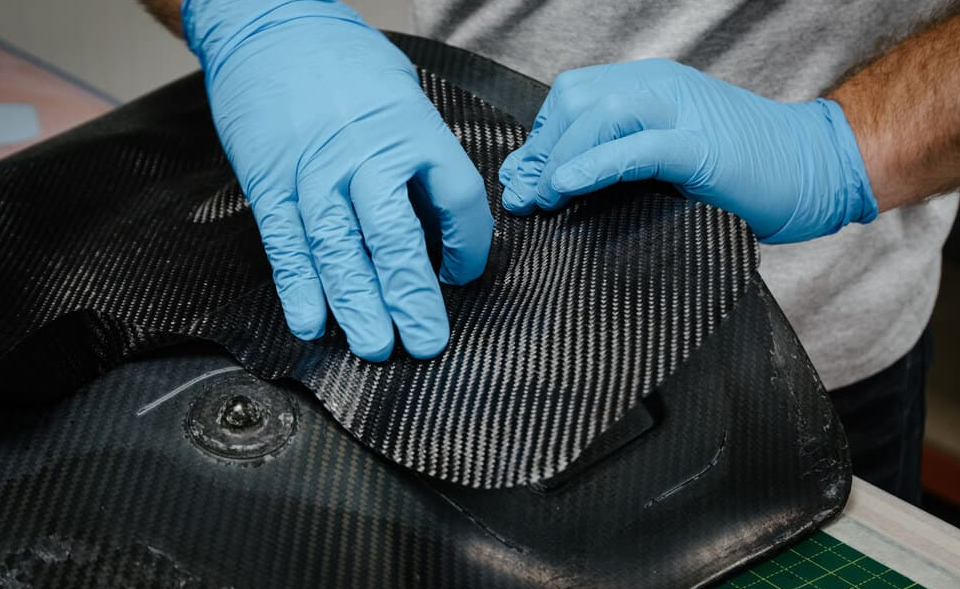
Carbon fiber has transformed race car design, from lightweight bodywork and aerodynamic components to structures that protect drivers during crashes. Once primarily associated with aerospace engineering, the material is now widely used in Formula 1, endurance racing, and other forms of motorsport. Weight savings are only part of its appeal. Carbon fiber composites allow engineers to build stiff, complex structures while controlling how individual components respond to mechanical loads.
Unlike conventional metals, carbon fiber composites can be engineered to provide different levels of stiffness and strength in different directions. Their performance depends on fiber orientation, resin selection, manufacturing quality, and component design. These advantages come with limitations, including high production costs, sensitivity to impact damage, and demanding repair procedures.
What Is Carbon Fiber and What Is It Made Of?
Carbon fiber consists of extremely thin filaments made predominantly of carbon atoms. Individual filaments typically measure 5–10 micrometers in diameter, making them considerably thinner than human hair. Their internal structure provides high tensile strength and stiffness relative to their weight. Thousands of filaments are grouped into bundles called tows. These bundles can be woven into fabric or arranged in parallel sheets, allowing manufacturers to position the fibers according to the forces a finished component must withstand.
It’s important to distinguish carbon fiber from carbon fiber-reinforced polymer (CFRP). Carbon fiber provides reinforcement, while most structural racing components use a composite material that combines the fibers with a polymer matrix, usually epoxy resin. Each constituent plays a different role:
- Carbon fibers carry much of the tensile load and provide stiffness along their orientation.
- Polymer resin holds the fibers together, transfers loads between them, and maintains the laminate’s integrity.
- Core materials, including aluminum honeycomb and structural foam, can separate composite skins to increase bending stiffness without adding substantial weight.
The resulting properties depend on the complete structure rather than the fibers alone. A decorative carbon fiber panel and a Formula 1 survival cell may have similar visible weaves, but their internal construction and mechanical requirements differ considerably.
How Is Carbon Fiber Manufactured?
Most commercial carbon fiber begins with polyacrylonitrile (PAN), a synthetic polymer processed into continuous precursor filaments. Converting these filaments into high-performance reinforcement requires several carefully controlled stages. Production starts with spinning the polymer into fine fibers. These undergo stabilization in an oxygen-containing atmosphere, generally at temperatures of 200–300°C. The treatment changes their molecular structure, allowing them to withstand subsequent heating without melting. The next stage is carbonization. The stabilized fibers pass through furnaces containing an inert atmosphere, commonly nitrogen, at temperatures around 1,000–1,500°C.
During this stage, much of the non-carbon material is removed, producing a carbon-rich structure. Further high-temperature treatment can increase fiber modulus, although greater stiffness does not necessarily translate into higher tensile strength. Manufacturers adjust processing conditions to produce grades suited to different structural requirements. After heat treatment, the fibers receive surface treatment and a thin coating called sizing. These processes improve handling and promote adhesion between the fibers and compatible resin systems.
Turning Carbon Fibers Into Racing Components
Producing carbon fibers is only the beginning. Manufacturing a racing component requires arranging them into a structure designed for specific mechanical loads. High-performance motorsport parts frequently use prepreg, a fabric or unidirectional tape pre-impregnated with a controlled amount of resin. Technicians cut the material into precise shapes before placing individual layers into a mold. Woven carbon fiber fabrics contain interlaced yarns running in different directions, making them useful for complex shapes and multidirectional reinforcement. Unidirectional materials concentrate fibers along a single axis, allowing more precise reinforcement in areas subjected to high directional loads. Each layer, known as a ply, may have a different fiber orientation. A laminate might combine layers positioned at 0°, 90°, +45°, and -45° to withstand loads acting in several directions. The stacking sequence follows the component’s structural requirements rather than a universal pattern.
Once the layers are positioned, the assembly is vacuum-bagged and cured. Many high-performance prepreg components undergo autoclave processing, where controlled heat and external pressure consolidate the laminate and help reduce voids. Other techniques include resin transfer molding and vacuum-assisted resin infusion. These methods may offer advantages for larger components, different production volumes, or manufacturing costs. Finished parts undergo trimming, machining, and inspection. Ultrasonic testing can reveal internal defects, including voids and delamination, that may not be visible from the surface. Precise fiber placement, controlled resin content, specialized equipment, and rigorous inspection all contribute to the expense of manufacturing carbon fiber components.
Key Properties of Carbon Fiber
Carbon fiber composites combine low density with high specific stiffness and strength. Their greatest advantage is not a single mechanical property but the ability to tailor a component’s behavior to its intended function.
Strength, Weight and Durability
Individual carbon fibers typically have densities around 1.75–1.95 g/cm³, compared with approximately 2.7 g/cm³ for aluminum and 7.8 g/cm³ for conventional steel. In typical epoxy-based CFRP laminates, the finished composite has a lower density than the carbon fibers themselves because the resin matrix is less dense. Many structural carbon fiber laminates have densities near 1.5–1.6 g/cm³, although the exact figure varies with fiber content and construction. Carbon fiber composites can deliver excellent strength-to-weight and stiffness-to-weight ratios. However, the tensile strength of an individual fiber should not be confused with the strength of a finished laminate, which depends on its construction and loading direction.
Other useful characteristics include good fatigue resistance under suitable loading conditions and relatively low thermal expansion along the fiber direction. Impact resistance requires more careful consideration. Carbon fiber composites do not rust like steel, but they can develop matrix cracks, broken fibers, and internal delamination. A seemingly minor impact may damage the laminate beneath an otherwise intact exterior surface. Unlike ductile metals, which can deform substantially before failure, composite structures may fracture with relatively little permanent deformation. Following significant contact or a crash, visual inspection alone may be insufficient. Ultrasonic or other nondestructive testing methods can help identify concealed damage.
How Fiber Orientation Changes Performance
Carbon fiber composites are generally anisotropic, meaning their mechanical properties vary with direction. A unidirectional laminate can be exceptionally stiff along its fibers but substantially less resistant to certain loads applied across them. Combining plies at different angles produces a more suitable balance of properties. For example, a suspension member designed primarily for axial loads may use fibers aligned along its length, with additional angled layers to handle torsion and local stresses.
An aerodynamic panel may instead require a laminate optimized for bending stiffness and resistance to distributed pressure. This design flexibility distinguishes composites from conventional metal components, whose properties are generally less dependent on direction. Reinforcement can be concentrated in heavily loaded areas without adding unnecessary material elsewhere.
Carbon Fiber vs Steel and Aluminum
Steel and aluminum remain important in motorsport because no single material offers the best combination of strength, toughness, weight, cost, and manufacturing flexibility for every component. Density is only part of the comparison. What matters is how a finished component performs under load.
| Property | Carbon Fiber Composite | Aluminum Alloy | Steel |
| Representative density | 1.5–1.6 g/cm³ | 2.7 g/cm³ | 7.8 g/cm³ |
| Stiffness | Direction-dependent; potentially very high | Moderate | High |
| Strength | Depends on laminate design | Depends on alloy and temper | Depends on grade and treatment |
| Impact behavior | May crack or delaminate | Often deforms plastically | Often deforms plastically |
| Corrosion | Does not rust; galvanic concerns at interfaces | Susceptible to corrosion | Often requires protection |
| Manufacturing cost | Generally high | Moderate | Often comparatively low |
| Repairability | Requires specialized assessment | Depends on component | Depends on component |
These are representative characteristics rather than universal specifications. Steel offers high toughness in suitable grades, predictable mechanical behavior, and established manufacturing methods. It remains valuable for fasteners, drivetrain components, and parts subjected to concentrated loads. Aluminum provides relatively low density alongside straightforward machining and fabrication.
Racing teams use it for brackets, housings, suspension hardware, and components where metal offers a practical balance of performance and cost. Carbon fiber is particularly effective in large structures requiring high stiffness at low weight, including monocoques, aerodynamic surfaces, and selected structural panels. Yet replacing a metal component with carbon fiber does not automatically reduce its mass. Reinforced attachment points, minimum laminate thickness, and damage-tolerance requirements can offset some of the material’s density advantage. Meaningful comparisons therefore involve complete components designed to meet equivalent structural requirements.
Advantages and Disadvantages of Carbon Fiber
Carbon fiber’s principal advantage is structural efficiency. Its combination of low density and customizable mechanical properties allows designers to optimize parts for demanding applications without relying on conventional metal construction. Composite manufacturing also supports complex geometries and integrated structures. A component that would require several metal pieces and mechanical joints may sometimes be manufactured as a more unified assembly.
Carefully engineered composites can absorb substantial crash energy through progressive crushing, making them valuable in motorsport safety systems. Those advantages come at a cost. Manufacturing requires specialized tooling, controlled curing processes, and extensive quality assurance. Complex parts can involve substantial manual labor, while damaged structures often need specialist assessment before repair or replacement. Heat presents another challenge. Although carbon fibers tolerate considerable temperatures, the polymer matrix determines the operating limits of many composites. Excessive heating can soften or degrade the resin and reduce structural performance.
Electrical conductivity introduces additional considerations. When carbon composites contact susceptible metals in the presence of an electrolyte, galvanic corrosion can occur unless suitable isolation measures are provided. Recycling is also more complicated than for conventional metals, particularly with thermoset composites. Processes exist to recover fibers, but reclaimed material may have different properties or require alternative manufacturing techniques. These trade-offs explain why racing cars continue to combine composites with metals rather than relying exclusively on carbon fiber.
How Carbon Fiber Is Used in Motorsport
Carbon fiber has become a defining material in modern racing, although its use varies according to technical regulations, vehicle design, and team budgets. One of the most significant milestones came in 1981, when McLaren introduced the MP4/1 Formula 1 car with a carbon fiber composite monocoque. The MP4/1 demonstrated how this construction could combine low weight and torsional stiffness with a robust driver survival structure, helping accelerate the material’s adoption in Formula 1. Today, carbon fiber-reinforced composites are used extensively in Formula 1 and prototype endurance racing, alongside selected applications in other competition categories.
Monocoques and Driver Protection
The monocoque is among the most demanding composite structures in motorsport. In Formula 1, the survival cell surrounds the driver and forms the central protective structure of the chassis. It must resist substantial loads while meeting strict weight, stiffness, and safety requirements. Survival cells commonly incorporate sandwich panels with carbon composite skins and lightweight cores. Locally reinforced sections accommodate concentrated loads and structural connections.
The complete structure undergoes prescribed safety testing, including static load and impact-related requirements. Its effectiveness depends on engineering design, manufacturing consistency, and successful validation rather than the presence of carbon fiber alone. Crash protection also involves components designed to absorb energy through controlled deformation and destruction. Composite crash structures can dissipate kinetic energy through progressive crushing, which breaks fibers and damages the surrounding matrix. The survival cell serves a different purpose: maintaining a protected space around the driver. This separation between energy absorption and occupant protection is fundamental to racing-car safety.
Suspension and Structural Components
Selected suspension members use carbon fiber composites to achieve high stiffness without unnecessary weight. Depending on their function, these components must withstand combinations of tensile, compressive, bending, and torsional loads. Limiting deflection helps maintain wheel alignment and consistent suspension geometry under racing conditions. Composite suspension members often incorporate metallic inserts or specially designed joints where they connect to the chassis and other hardware. These areas require careful engineering because loads must transfer reliably between materials with different mechanical properties.
Bodywork and Exterior Panels
Carbon fiber is widely used for lightweight bodywork, including engine covers, access panels, floor sections, and other exterior components. These parts can combine complex shapes with sufficient stiffness to resist vibration and operational loads. Some are primarily nonstructural covers, while others contribute to the vehicle’s overall performance. Material selection also depends on racing regulations. Certain categories restrict composite construction through cost controls, homologation requirements, or technical rules intended to maintain competitive balance.
Racing Car Components and Aerodynamics
Aerodynamic components must retain carefully controlled shapes while experiencing substantial forces at racing speeds. Front wings, rear wings, splitters, diffusers, and underbody structures all influence airflow around the vehicle. Unwanted deformation can change aerodynamic balance, affecting downforce, drag, and handling. Carbon fiber composites make it possible to maintain the required aerodynamic geometry without the weight penalty associated with some alternative constructions.
Maintaining Aerodynamic Shape Under Load
Aerodynamic forces increase approximately with the square of vehicle speed when other relevant conditions remain constant. A component that experiences modest loading at lower speeds may therefore face much greater forces as the car accelerates. A front wing must withstand distributed aerodynamic pressure while maintaining its intended geometry within the limits established by technical regulations.
Engineers adjust laminate thickness, fiber orientation, and internal reinforcement to control deformation. Sandwich construction is particularly useful for larger surfaces because lightweight cores increase bending stiffness without requiring thick, solid laminates. More reinforcement is not always beneficial. Additional material increases weight, while insufficient stiffness can produce unwanted deflection or structural failure. The design challenge is to achieve the required behavior without compromising durability or exceeding regulatory limits.
Weight Distribution and Vehicle Dynamics
Reducing mass can influence vehicle dynamics as well as acceleration and braking performance. Replacing heavy bodywork mounted high on the chassis with lighter composite panels can lower the center of gravity. This can reduce total lateral load transfer during cornering. Suspension geometry and roll stiffness distribution also influence how that load transfer is shared between the axles. In racing categories with minimum vehicle weights, lighter components can give engineers greater freedom to position ballast.
Concentrating adjustable mass in advantageous locations helps teams refine vehicle balance. The location of the weight savings matters just as much as the amount removed. Reducing mass from an unsprung suspension component can affect wheel control differently from removing the same amount from a body panel. Carbon fiber therefore contributes not only to lower vehicle weight but also to more flexible chassis design and mass distribution.
Other Common Applications of Carbon Fiber
Although motorsport is one of carbon fiber’s most visible applications, the material is used across numerous industries. Aerospace manufacturers employ carbon fiber composites in aircraft structures because of their high specific strength, stiffness, and potential for weight reduction. Similar characteristics make them useful in spacecraft and satellite components. Cycling manufacturers use carbon fiber for frames, forks, and wheels. By adjusting laminate construction, designers can balance stiffness, strength, and compliance while producing aerodynamic shapes that would be difficult to manufacture using conventional metal tubing. Other sporting applications include tennis rackets, golf club shafts, hockey sticks, and selected protective equipment.
Each product requires a different combination of fibers, resin systems, and structural design. Robotics, industrial machinery, and medical devices also benefit from lightweight components with controlled stiffness. In road cars, carbon fiber is most common in high-performance and limited-production models. Its wider adoption remains restricted by material costs, manufacturing time, repair requirements, and the difficulty of scaling production. Across these applications, the strongest case for carbon fiber arises when its structural properties justify the additional manufacturing complexity.
FAQ
Is carbon fiber stronger than steel?
Individual carbon fibers can offer substantially greater tensile strength relative to their weight than many steels. However, the strength of a finished composite depends on fiber orientation, resin, and laminate construction. Steel may perform better where ductility, toughness, or resistance to concentrated impacts is essential.
Why is carbon fiber so expensive?
Producing carbon fiber requires energy-intensive thermal processing and specialized equipment. Manufacturing structural components adds costs for precise material placement, curing, tooling, inspection, and testing. Complex racing parts can be considerably more expensive than the raw material alone.
Can carbon fiber break in a crash?
Yes. Carbon fiber composites can fracture, develop matrix cracks, or suffer internal delamination under excessive loads. Some crash structures are deliberately designed to break progressively and absorb energy. Other components require inspection after an impact because significant damage may remain hidden beneath the surface.
Is carbon fiber lighter than aluminum?
Most structural carbon fiber composites have a lower density than aluminum alloys. A typical CFRP laminate may have a density near 1.5–1.6 g/cm³, compared with approximately 2.7 g/cm³ for aluminum. However, the final component’s weight depends on its geometry, reinforcement, and structural requirements.
Why Don’t Racing Teams Make Every Component From Carbon Fiber?
Carbon fiber is unsuitable for some mechanical, thermal, and manufacturing requirements. Metals remain preferable for many engine components, transmissions, fasteners, and highly loaded connections. Cost restrictions, repairability, and racing regulations also influence material selection.